
Service Dogs vs Emotional Support Dogs and Working Dogs Explained
A dog can be a loyal companion, a lifeline, a teammate, and a protector. Some dogs comfort people through hard seasons. Others perform trained tasks that help a person move through the world safely. Some search disaster sites, detect danger, guard livestock, or serve alongside military and law enforcement teams.
Because these roles can sound similar, people often use the terms interchangeably. They are not the same. Understanding the difference helps protect the rights of people with disabilities, respects the dogs doing real jobs, and clears up confusion in public places.
This guide explains service dogs vs emotional support dogs and working dogs in plain language, including what each dog does, where they are allowed, and how to behave when meeting one.

Service dogs are trained to perform disability-related tasks
A service dog is a dog that has been individually trained to do specific work or tasks for a person with a disability. The key word is trained. These dogs do more than provide comfort by being present. They take specific actions when their handler needs help.
Under the Americans with Disabilities Act, commonly called the ADA, service dogs have public access rights in many places where pets are not allowed. That can include stores, restaurants, hotels, airports, public transportation, and other public spaces.
Service dogs are trained for many different needs. Some tasks are visible, while others may not be obvious to strangers.
Service dogs may be trained to:
Guide a person who is blind or has low vision
Alert a person who is deaf or hard of hearing
Retrieve dropped items
Open doors or press accessible buttons
Provide balance or mobility support
Alert to certain medical changes, such as blood sugar changes
Respond to seizures
Interrupt harmful behaviors
Create space for a handler with PTSD
Wake a handler from nightmares or guide them to an exit
A service dog’s work is tied directly to the handler’s disability. For example, a dog that lies across a handler’s lap on command during a panic episode may be performing a trained psychiatric service task. A dog that simply makes someone feel calmer by sitting nearby may be an emotional support dog instead.
Both can be meaningful. Only one has been trained to perform disability-related tasks.
Service dogs are not always easy to identify
Many people picture a guide dog in a harness. Guide dogs are one important type of service dog, but they are not the only type.
A service dog might help someone with diabetes, epilepsy, autism, mobility limitations, PTSD, or another qualifying disability. Some handlers have disabilities that are not visible. A person may look healthy and still rely on a service dog for safety and independence.
There is also no single national service dog vest, ID card, or certification that proves a dog is a service dog under the ADA. Some handlers use vests or patches because they reduce questions in public. Others do not.
Businesses covered by the ADA may generally ask only two questions when the need for the dog is not obvious:
Is the dog a service animal required because of a disability?
What work or task has the dog been trained to perform?
They may not ask about the person’s diagnosis, require the dog to demonstrate the task, or demand special certification. At the same time, a service dog must remain under control and should be housebroken. If a dog is out of control and the handler does not correct it, or if the dog is not housebroken, a business may be allowed to ask that the dog be removed.
This balance matters. It protects disabled handlers from unfair barriers while also setting clear expectations for behavior.
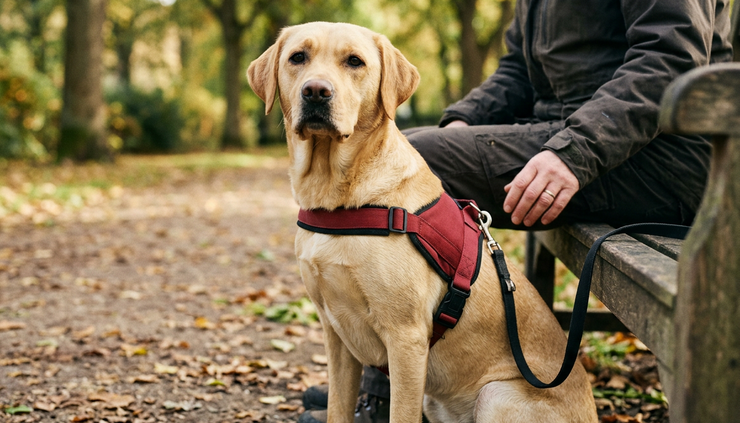
Emotional support dogs provide comfort through companionship
An emotional support dog provides comfort, stability, and companionship to a person with a mental or emotional health condition. These dogs can play a powerful role in daily life. Their presence may help reduce loneliness, ease anxiety, support routine, and offer comfort during grief, depression, or trauma recovery.
The main difference is that emotional support dogs are not trained to perform specific tasks related to a disability. Their support comes through companionship.
An emotional support dog may help someone by:
Offering calming presence during anxious moments
Encouraging a daily routine
Providing companionship during isolation
Helping a person feel safer at home
Supporting emotional stability through affection and connection
These benefits are real for many people. Still, emotional support dogs do not have the same public access rights as service dogs under the ADA.
That means an emotional support dog is generally not allowed inside restaurants, grocery stores, hotels, or other no-pet public spaces simply because of emotional support status. Some housing protections may apply under federal housing rules when a person has a disability-related need, but those rules are different from ADA public access rules.
Air travel rules have also changed in recent years. U.S. airlines are generally not required to treat emotional support animals as service animals. Policies can vary for pets, so travelers should check with the airline before flying.
This article is informational only and should not be treated as legal or medical advice. For specific questions about disability rights, housing, or travel, speak with a qualified professional or the relevant agency.
Emotional support dogs still need good manners
Even when a dog provides emotional support at home, training matters. A calm, well-socialized dog can better support a person’s daily life and is less likely to create stress.
Helpful skills for emotional support dogs include:
Walking politely on a leash
Responding to basic cues
Staying calm around common household sounds
Greeting people gently
Settling quietly
Handling routine vet care and grooming
An emotional support dog does not need the same advanced task training as a service dog. Still, responsible ownership matters. The dog’s welfare matters too. A dog that is anxious, overwhelmed, or placed in stressful public situations may struggle to provide comfort.
Working dogs perform jobs for people, communities, and animals
A working dog is a broad term for a dog trained to do a job. Some working dogs help one handler. Others serve a team, agency, farm, ranch, or community. Their work may involve safety, search, protection, detection, herding, or rescue.
Working dogs often train for specific environments that would overwhelm most pets. They may work in airports, wilderness areas, disaster zones, farms, military settings, or controlled law enforcement situations.
Common types of working dogs include:
Search and rescue dogs
Police K9s
Military working dogs
Detection dogs trained to find explosives, narcotics, or human remains
Livestock guardian dogs
Herding dogs
Conservation detection dogs
Sled dogs in appropriate climates and settings
Some working dogs have public-facing roles. Others work mostly out of sight. A search and rescue dog may work through rough terrain to find a missing person. A detection dog may screen luggage or vehicles. A livestock guardian dog may live with sheep or goats to protect them from predators.
Working dogs are not automatically service dogs under the ADA. A police K9, for example, is a working dog, but it is not a service dog for a person with a disability. A therapy dog that visits hospitals or schools is also not a service dog unless it is trained to perform disability-related tasks for its handler.

The main differences come down to training, purpose, and access
The easiest way to separate these categories is to ask three questions.
What is the dog trained to do?
Who does the dog help?
Where does the dog have legal access?
Type of dog | Main purpose | Training | Public access under the ADA |
Service dog | Helps one person with a disability by performing specific tasks | Individually trained for disability-related work | Yes, in most public places where the handler may go |
Emotional support dog | Provides comfort and emotional support through companionship | No task training required under the ADA | No, not as a service animal |
Working dog | Performs a job such as search, detection, protection, herding, or rescue | Trained for a specific job or environment | Not automatically, depends on role and setting |
The categories can overlap in everyday language, which causes confusion. A service dog is a type of working dog in the general sense because it has a job. But legally, “service dog” has a specific meaning. Emotional support dogs work hard in an emotional sense, but they are not working dogs in the same job-trained or legal-access sense.
Clear language helps everyone. It helps businesses follow the law. It helps handlers avoid unnecessary conflict. It also helps the public respect dogs that are actively working.
Veterans and first responders may rely on highly trained dogs
Dogs can play an especially meaningful role for veterans, first responders, and military personnel. Some people in these groups live with PTSD, traumatic brain injury, mobility changes, hearing loss, or other conditions connected to their service or work.
A trained service dog may help by:
Interrupting panic episodes
Creating physical space in crowded areas
Waking a handler from nightmares
Guiding a handler to an exit
Reminding a handler to take medication
Retrieving help or a phone
Providing balance support
These tasks are different from general comfort. A dog that senses distress and performs a trained response can help a handler regain control, move to safety, or complete daily activities with more confidence.
Emotional support dogs can also help veterans and first responders by offering companionship and comfort at home. The distinction is not about which dog matters more. The distinction is about the dog’s training, role, and legal status.
Therapy dogs are another separate category
Therapy dogs often get grouped into the same conversation, but they have a different role. A therapy dog usually visits places such as hospitals, schools, libraries, nursing homes, or disaster recovery areas to comfort many people.
Unlike a service dog, a therapy dog is not trained to assist one disabled handler with specific tasks. Unlike an emotional support dog, a therapy dog often works through an organized program and interacts with the public in approved settings.
Therapy dogs can be wonderful, but they do not have ADA public access rights simply because they are therapy dogs. They go where they are invited or permitted.
How to behave around service dogs and working dogs
The safest rule is simple: if a dog appears to be working, do not distract it.
That means no petting, calling, whistling, feeding, or making kissy noises. Even a brief distraction can interfere with the dog’s job. For a service dog handler, that could mean missing a medical alert, losing balance support, or having a task interrupted.
Good etiquette includes:
Speak to the handler, not the dog
Ask before interacting with any dog
Accept “no” without taking it personally
Keep your own dog at a safe distance
Do not ask personal questions about someone’s disability
Give the team space in aisles, elevators, and lines
Parents can help children understand that a working dog is not being unfriendly. The dog is concentrating. A simple explanation works well: “That dog has a job right now, so we let it work.”

Why fake service dog claims cause real harm
Misrepresenting a pet as a service dog may seem harmless to some people, but it creates serious problems. An untrained dog in a public space can bark, lunge, sniff food, have accidents, or distract a real service dog. That can put disabled handlers at risk.
Fake claims also make life harder for legitimate service dog teams. Handlers may face more suspicion, more questioning, and more conflict because others have abused the rules.
A real service dog is not just a well-behaved pet in a vest. It is a trained partner that performs specific tasks for a person with a disability. Respecting that standard protects everyone, including the dogs.
No single role is better than another
Service dogs, emotional support dogs, and working dogs all improve human lives in different ways.
A service dog may help one person cross a street, manage a medical condition, or face a crowded store. An emotional support dog may help someone get through grief, depression, or anxiety at home. A working dog may find a missing person, detect danger, protect livestock, or serve beside a handler in difficult conditions.
The differences matter because the jobs are different. The laws are different too.
When people use the right terms, they show respect for the dog, the handler, and the role. These heroes with paws may not all do the same work, but each one reminds us how powerful the bond between people and dogs can be.


I have been wanting to do this post since we started. I hope you enjoyed this!